
Fuel Induction Systems
Fuel System Overhaul & Tuning
After decades of service, your classic car’s fuel induction system – whether carburetted or fuel-injected – may require attention. Over time, the internal components of these systems can wear, leading to poor fuel delivery, reduced engine performance, or unreliable starting.
At CMT, we specialise in the restoration and tuning of classic carburettors and fuel injection systems. We return them to their original condition and functionality with precision and care.
We have extensive experience with rebuilding and restoring carburettors made by:
- Solex
- Weber
- Zenith
- Stromberg
- Pierburg
We also service Bosch fuel injection systems, including:
- MFI (Mechanical Fuel Injection)
- D-Jetronic
- K-Jetronic
- KE-Jectronic (Electronic Fuel Injection)
For fuel induction systems that are functional but in need of tuning or calibration, we offer on-vehicle fuel tuning and adjustment services to restore optimal performance.
Carburettors
A carburettor is a mechanical device used by a petrol internal combustion engine to control and mix air and fuel entering the engine. The main method of adding fuel to the intake air is with a venturi tube in the main metering circuit. Other components and jets are also used to provide extra fuel or air to cater for acceleration and varying altitude.
Since the 1990’s, carburettors have been largely replaced by fuel injection systems for cars with the onset of tightening emission standards. Catalytic convertors require a feedback circuit to control the mixture and this can only be supplied with electronic fuel injection. Carburettors are still used by some small engines such as lawnmowers, generators, and motorbikes. They are still widely used on piston engine driven aeroplanes.
The advantages of carburation are relative simplicity and manufacturing cost. The disadvantages are the difficulty of regulating the air-fuel mixture over the full engine revolution range, during acceleration and deceleration, varying altitude, and seasonal temperature changes.
Solex
Solex is a brand name owned by a subsidiary of Italian automotive parts manufacturer,
Magnetti Marelli. The original Solex company was French-owned and produced
carburettors and petrol-powered bicycles.
Solex carburettors were used by many European automotive companies including Rolls-
Royce Motors, Land Rover, Mercedes-Benz, Volkswagen, and Porsche, and were also
licensed to Japanese maker Mikuni. However, they are no longer made by any derivation of
the original French firm.
The carburettor shown in the following six photos is the Solex 40 PI as used in the Porsche 911 up to early 1966. The 40 PI is an overflow type of carburettor and six are required for the 911.
The pictures show a Solex 40 PI overhauled by us:


Weber
The Weber carburettor company was established in 1923 as Fabbrica Italiana Carburatori
Weber by Edoardo Weber. Production was based at Bologna, Italy until 1992 when the
company relocated to Madrid, Spain. Fiat has controlled the company since 1952 and
merged its operation with Solex in 1986 as part of Magnetti Marelli Powertrain S.p.A.
Weber carburettors have been used by a wide variety of car manufacturers such as, Alfa
Romeo, Aston Martin, Ferrari, Fiat, Lamborghini, Lancia, etc.
The carburettor shown in the following six photos is a 40 IDA 3C type as used in the Porsche 911 from 1966 to 1969. It is a triple downdraught type of carburettor and two are required for the 6 cylinder 911.
The pictures show a Weber 40 IDA 3C overhauled by us:


Zenith
The Zenith Carburettor company was founded in 1912 in England. It was a subsidiary of the French company, Société du carburateur Zénith. In 1965 Zenith merged with the rival Solex carburettor company.
Zenith carburettors were used on cars made by Jaguar, Saab, Volvo, and others. The
carburettor shown in the following six photos is a 40 TIN type. It is of a triple downdraught design, like the Weber 40 IDA. Two are required for the Porsche 911.
The pictures show a Zenith 40 TIN overhauled by us:


Stromberg
Stromberg carburettors were made by the company, Zenith carburettors. Designed and
developed by Dennis Barbet (Standard Triumph) and Harry Cartwright (Zenith) to bypass
SU’s patents, the Stromberg carburettor features a variable venturi controlled by a piston. It is similar in appearance to the SU type of carburettor.
Zenith-Stromberg carburettors were used in many British cars during the 1960s. Examples
include Jaguar E-Type, Hillman Minx, Sunbeam Alpine, amongst others.
The carburettor shown in the following six photos is a 175 CD-2. It is fitted to a V12 5.3 litre E-Type and four are required.
The pictures show a 175 CD-2 overhauled by us:


Fuel Injection
The primary benefit of fuel injection over carburation is the creation of very fine droplets of fuel through atomisation as the fuel is injected under pressure into the manifold or
combustion chamber. This aids the reduction of harmful emissions in the exhaust gases as the larger surface area of the fuel droplets enables a more complete combustion. The
disadvantages of fuel injection over carburation are the high parts cost and complexity of
the system.
There are two basic types of fuel injection system – direct and indirect. Direct sprays into
the combustion chamber under very high pressures. Indirect sprays into the intake manifold upstream of the intake valve, but at far lower pressures.
Bosch designed the first fuel injection system for petrol engines. It was derived from diesel injection systems. These are of a mechanical nature and use a very high-pressure pump to overcome the pressures developed in the combustion chamber. The first use was in the Messerschmitt Bf109 fighter plane. One of the first to the market for petrol cars was a direct fuel injection system made by Bosch and used on the 1955 Mercedes 300 SL (W198). Indirect mechanical fuel injection systems were developed by Bosch during the 1960’s. These are cheaper to make and gave better control of fuel atomisation than carburettors. This was an essential requirement to lower harmful emissions from combustion engines during the 1970’s.
The modern electronic indirect fuel injection system was created by the Bendix Corporation in 1957. Electronic indirect fuel injection uses lower pressures (typically from 2 to 5 Bar) than mechanical direct injection (approximately 39 to 47 Bar on the 300 SL) or mechanical indirect injection (approximately 17 Bar in the Bosch MFI) and is easier to control with fast responding electronics. By the mid 1970’s electronic fuel injection (EFI) had taken over from mechanical fuel injection (MFI).
CMT Europe has experience of both the Bosch MFI and EFI (D-Jetronic and KE-Jetronic)
systems.
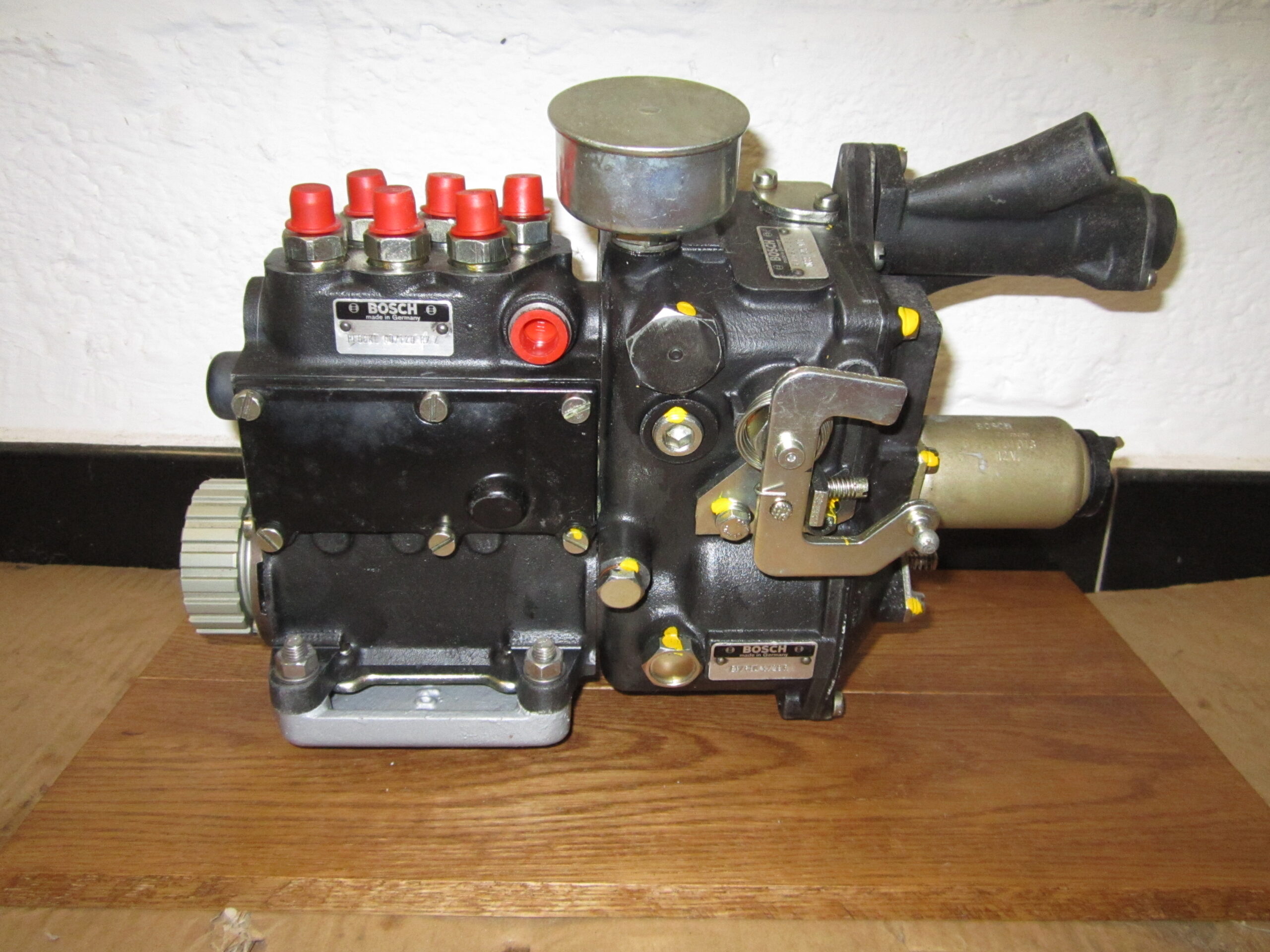
Bosch MFI System
The MFI pump consists of two main parts – the fuel pump assembly and the compensating unit. The fuel pump assembly controls the delivery of fuel to each of the cylinders, while the compensating unit controls the fuel delivery according to the levels set by both the accelerator and the engine speed.
The following pictures show an MFI system as used on a Porsche 911 2.0S from 1969:


Bosch D-Jetronic System
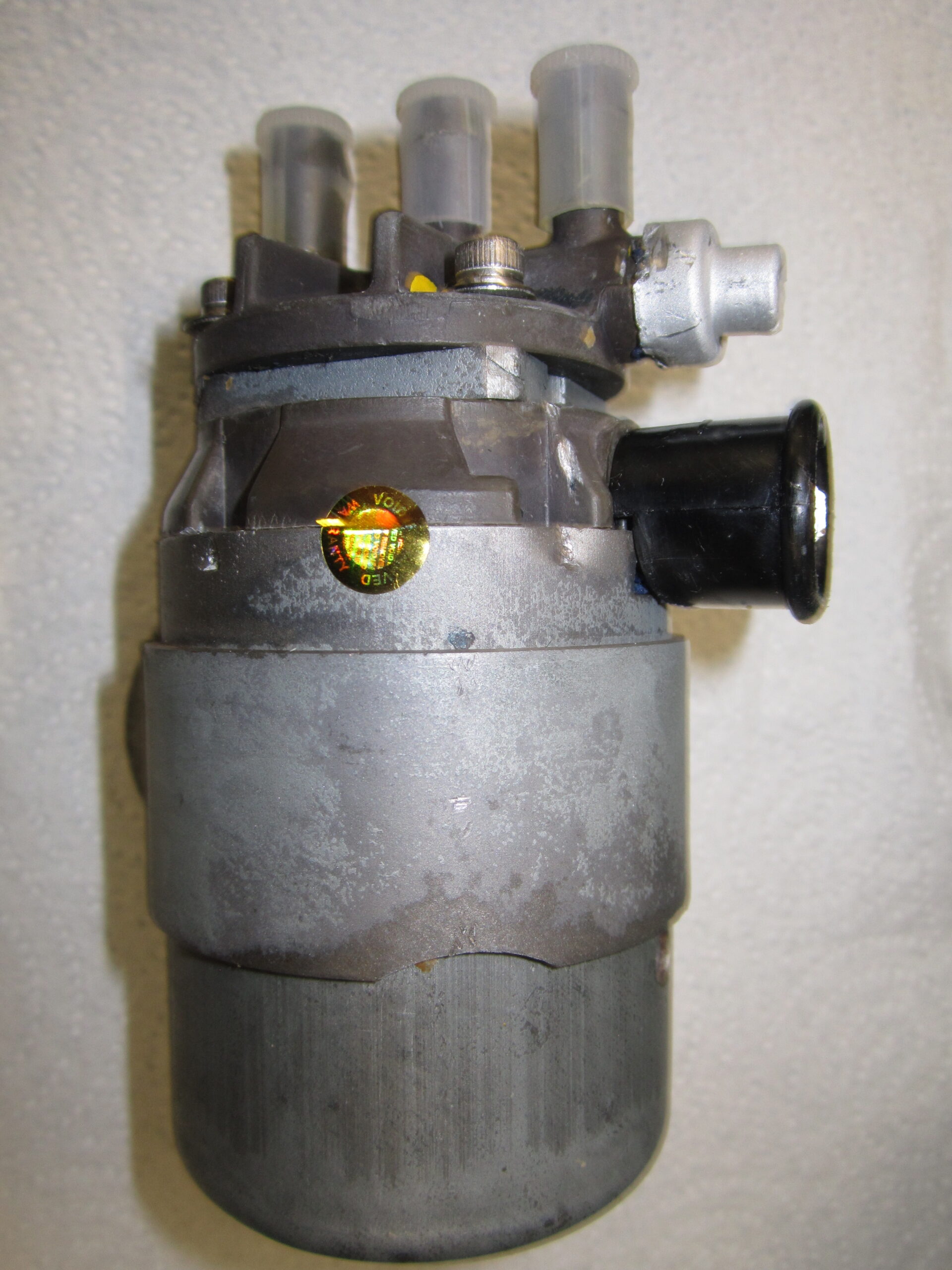
The Bosch D-Jetronic fuel injection system uses manifold pressure to regulate the fuel delivery. The ‘D’ in the title stands for Druck (pressure) in German. It is an analogue electronic system. A sensor (called the MPS or manifold pressure sensor) monitors the differential pressure across the throttle valve to control the amount of fuel injected. An electric fuel pump generates 2.0 Bar of pressure which is fed to a fuel injection valve in the inlet port of each cylinder.
The D-Jetronic system was used on the Mercedes-Benz SL R107, Porsche 914, Saab 99E, Volvo 144, VW 411/412, and others.
The following pictures show a D-Jetronic system as used on a Porsche 914 2.0L from 1973:




Bosch KE-Jetronic System
The KE-Jetronic injection system is a derivation of the mechanical K-Jetronic injection
system. K-Jetronic was first used on the 1973 Porsche 911T. The K means Kontinuierlich in German. This translates as “continuous” in English. The fuel is not pulsed but flows continuously from all injectors into the intake manifold.
KE-Jetronic is a refinement of the original mechanical control and uses an ECU (electronic
control unit) to control the fuel mixture. The typical fuel pressure is 5.3 to 5.5 Bar. The fuel is pressurised and fed to a fuel distributor mounted on top of a control vane. The control vane is deflected by the air flow into the engine and correspondingly measures it. The control vane adjusts the opening of a fuel valve which then regulates the fuel volume to each injector. This basic mixture is adjusted dynamically by an electro-hydraulic pressure actuator which is under the control of the ECU. The ECU monitors a lambda sensor mounted in the exhaust, which senses the oxygen content, to adjust the air-fuel mixture.
The K-Jetronic type of fuel injection was utilised by Audi, Bentley, BMW, Ferrari, Mercedes-Benz, Porsche, and Volvo, amongst others.
The following pictures show a KE-Jetronic system installed in a Mercedes-Benz 230TE:


Copyright 2025 CMT Europe bv